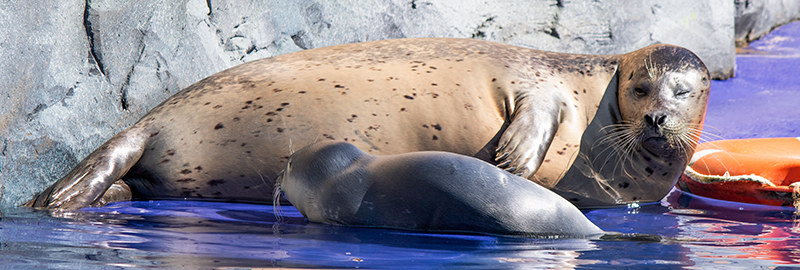
| Species | Common Seal, also known as Harbour Seal
| | Latin name | Phoca vitulina
| | Distribution (world) | Britain, Norway, Holland, Denmark, Iceland, East and West coast of Canada, Alaska, California and Hokkaido (Japan)
| | Distribution (Britain) | Scottish Mainland and Islands, Northern Ireland, The Wash and the East Coast of England.
| | Size | Males up to 1.8 metres and 120kg
| | Females up to 1.5 metres and 100kg
| | Longevity | In the wild males may live up to 20 years old and females to 25 years old.
In captivity males and females live slightly longer.
| | Breeding | Males reach sexual maturity at 4 - 6 years old,
Females at 3 - 5 years.
| | Pupping Sites | Sheltered rocky islands, sand banks and estuaries.
| |
|
The common seal pupping season peaks in June and July. Pups weigh approximately 10kg and measure 85cm long at birth. They are born with their adult coat (black or brown in colour), as the white natal-coat is usually shed before birth, and can swim immediately, sometimes they are even born in water. A mother is attentive to her pup and stays close during the weeks she nurses it, often carrying them on their backs, or forcing them under the surface if danger threatens.
|
|
| The pup feeds on the mothers milk which is extremely rich (45% fat), and suckling takes place either on land or in water. However, the care lasts for a very short time and at 4 weeks old the mother weans her pup and it is then completely independent from its mother. At this stage the pup will weigh between 20kg and 30kg. The pups have to then learn to catch fish, they do this by instinct.
Seals feed on a wide variety of fish and invertebrates, taking species which are locally abundant and easy to catch. In Scotland, Gadoid fish, particularly Whiting and Saithe, Herring and Sand-eels are important. Molluscs, such as Whelks and Octopus are also eaten.
|
|